The electromagnetic spectrum does not announce itself. It carries no flag, fires no round, leaves no crater. But in every modern conflict, it is the first domain fought over and the last line surrendered, because whoever controls it controls everything else.
Patrick Creighton, Vice President and General Manager, Electronic Warfare, L3Harris, has spent his career in that invisible fight. He recognizes that the threats are faster. The adversaries are better resourced. And the old model of single-function, platform-specific electronic warfare (EW) systems are no longer enough.
"EW is necessary in just about every defensive and offensive system being produced today," Creighton said. "To ensure survivability. To ensure effectiveness."
What L3Harris is building now is not just a better system. It is better architecture designed to scale, adapt and connect across every domain, platform and partner.
The Commercial Revolution
Historically, capability and cost moved in the same direction. The hardware required to sense, analyze and jam across a wide frequency range was expensive, heavy and purpose-built. That kept advanced EW confined to a small number of well-funded programs and the platforms large enough to carry them.
Then the commercial electronics market rewrote the equation.
“Rapid advancements in the commercial marketplace are making increasingly capable hardware available at lower cost, enabling us to deliver advanced software-based capabilities on top of that hardware far more affordably,” Creighton said.
The result is a fundamental shift in what is possible with systems that can be fielded on unmanned platforms, rotary-wing aircraft, ground vehicles and expendable launched effects.
Build Your System: The Modular EW Portfolio
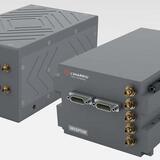
The answer L3Harris developed is a modular EW portfolio, and the logic behind it is straightforward enough to explain, even if the engineering behind it is anything but simple.
A military picks their form factor. From there, they select their software-defined radios and commercial off-the-shelf hardware that determine frequency band coverage.
Then comes the layer that makes it genuinely different.
"We are applying an open architecture middleware layer across all of these products," Creighton said, "Not just on our modular EW portfolio, but across many of the products we're building today."
Once it is in place, capabilities – what Creighton calls "skills” – can be loaded onto the system. Those skills can come from L3Harris or from third parties. They can be updated, swapped or reconfigured in the field. And the system itself is no longer locked into a single function.
"These are no longer single-solution capabilities but genuinely multifunctional systems,” Creighton said. “A single system can be adapted for defensive operations, offensive missions or intelligence collection."
DiSCO™: The System That Ties It All Together
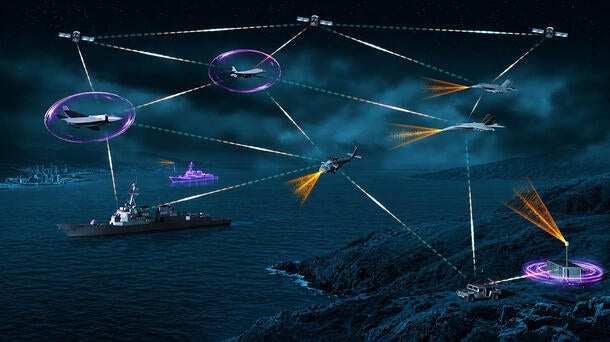
Modular systems create a new problem. When you have distributed reconfigurable EW payloads operating across multiple platforms, domains and operators, how do you command and control them?
That is the problem Distributed Spectrum Collaboration Operations (DiSCO) was built to solve.
DiSCO is L3Harris' enterprise-level electromagnetic battle management architecture. Developed in partnership with leading cloud providers, it fuses battlefield sensors, data links and communication methods into a single EW network, employing artificial intelligence and machine learning to reduce unknown signal identification from months to minutes.
"As modular, disparate systems continue to proliferate, an electromagnetic battle management system becomes essential for coordinating non-kinetic sensors and effectors," Creighton said. "This is where our DiSCO ecosystem comes in."
Built on open standards and already demonstrated with third-party software, DiSCO explicitly prevents vendor lock.