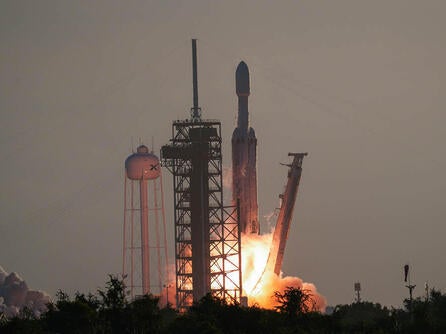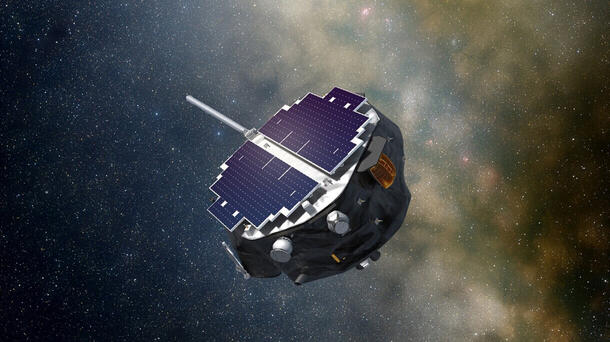
With precision steering enabled by L3Harris thrusters, NASA’s IMAP (Interstellar Mapping and Acceleration Probe) spacecraft will soon be on its way to its new orbital home, Lagrange Point 1 (L1), where it will help researchers study the heliosphere and its interaction with material from interstellar space. L3Harris designed, built and integrated IMAP’s propulsion system at its facility in Redmond, Washington. The spacecraft is scheduled to launch on September 24, 2025.
IMAP is equipped with 10 scientific instruments designed to investigate two key heliophysics issues: how charged particles are energized by the sun, and how this wind interacts with interstellar space at the heliosphere's boundary. This boundary protects our solar system from harsh galactic radiation, playing a crucial role in maintaining a habitable environment and supporting life. IMAP will also provide real-time observations of the solar wind, which can endanger technology and astronauts in space and disrupt global communications and electrical grids on Earth.
“Knowing that the propulsion system our team designed, built and installed on the IMAP spacecraft will enable researchers to expand our knowledge of our galactic neighborhood is very rewarding,” said Matt Carollo, director of the Space Systems Program Office at L3Harris’ Aerojet Rocketdyne segment. “The propulsion subsystem on IMAP is essential to ensuring we can capture valuable data throughout the mission.”
The L3Harris propulsion subsystem is a fundamental component of the spacecraft, providing the necessary thrust and control for various phases of the mission. It is comprised of three propellant tanks, two service valves, two latch valves, two system filters, two pressure transducers, temperature sensors, heaters and 12 MR-111G monopropellant rocket engines.
“Our thrusters enable IMAP’s attitude control system to steer the spacecraft, perform orbit insertion, adjust its spin rate and perform corrective maneuvers as needed to maintain its orbit,” said Chris Sebastian, lead program engineer. “Without a reliable propulsion system, our ability to map and understand solar wind processes would be significantly compromised."
Princeton University professor and principal investigator, David J. McComas, leads the IMAP mission with an international team of more than 27 partner institutions. The Johns Hopkins Applied Physics Laboratory in Laurel, Maryland, managed the development phase, built the spacecraft, and operates the mission. The IMAP mission is under NASA’s Heliophysics Division within the agency’s Science Mission Directorate.