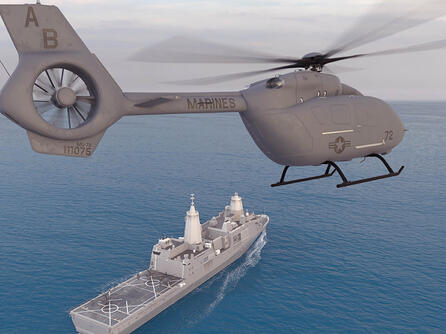
As the Marine Corps prepares for distributed operations in increasingly contested theaters, the ability to move critical supplies without putting pilots at risk is essential. The Aerial Logistics Connector (ALC) program is designed to meet that moment and recently took a step forward in proving the future of contested logistics.
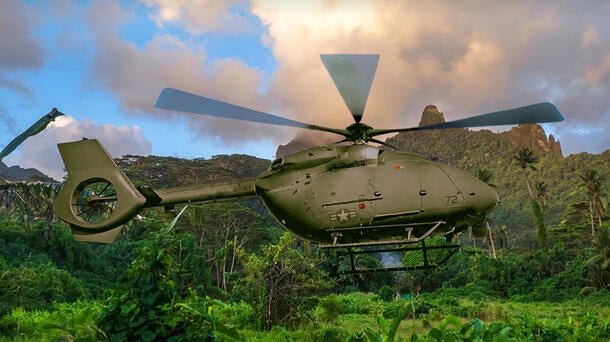
Airbus U.S. Space & Defense, alongside L3Harris Technologies, Shield AI and Parry Labs, successfully completed a fourth autonomous flight test of the MQ-72C Lakota Connector. For the first time, all four partners’ technologies operated together aboard an H-145 aircraft, executing autonomous flight while avoiding obstacles and safely landing in conditions that mirror real-world environments.
From Prototype to Operational Advantage
An autonomous variant of the UH-72 Lakota platform, the MQ-72C brings together a proven airframe with advanced autonomy and open architecture, creating a low-risk, affordable pathway to unmanned logistics at scale. This is not a clean-sheet concept. It is a rapid prototyping effort grounded in operational reality. With an active U.S. production line, the system is designed to evolve, quickly integrate new capabilities and deliver value across the joint force.
By leveraging a Modular Open Systems Approach (MOSA), the team is enabling rapid integration of new technologies, from autonomy software to future payloads such as signals intelligence and launched effects. The result is a platform that can adapt as fast as the threat environment changes. For the Marine Corps, that means greater flexibility, faster fielding and the ability to sustain forces in theaters where traditional logistics cannot operate.
The Digital Backbone: Making ALC Work
Autonomy cannot succeed on software alone. It requires a mission system that can connect, integrate and scale. That is where L3Harris delivers decisive value. As the lead systems integrator, L3Harris is providing the digital backbone that turns individual technologies into a unified, combat-ready system of systems. Through the use of MOSA, the company enables seamless integration of third-party and commercial technologies, accelerating development while reducing risk.
With more than six decades of experience in aircraft integration, electronic warfare, communications and network-enabled systems, L3Harris brings the expertise required to move from prototype to operational readiness. Its platform-agnostic integration model ensures that new sensors, payloads and capabilities can be added quickly without redesigning the system. The result is a logistics connector that is built for continuous evolution.
In a future fight defined by distance, denial and disruption and adaptability will determine success. The Marine Corps needs a capability that keeps pace with the fight, and the MQ-72C Lakota Connector continues to prove it will.