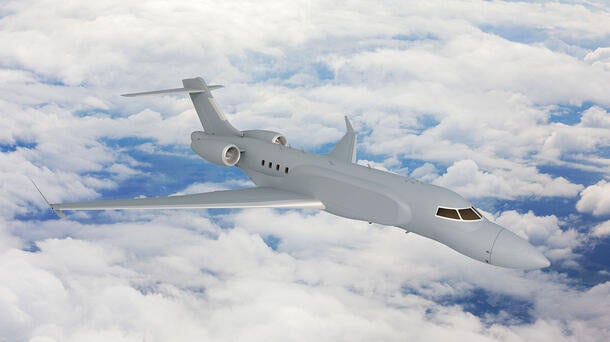
Allied nations across Europe, the Indo-Pacific, Middle East and the Americas face the same strategic reality: homeland defense requires persistent airspace awareness now – not in 2035. Legacy large-platform approaches deliver crippling lifecycle costs and limited availability as aging platforms become increasingly difficult to sustain. As a result, allies are accelerating efforts to field more agile, interoperable and survivable capabilities for rapid deployment.
Aligned with the fundamental shift in how allies approach airborne intelligence, surveillance and reconnaissance (ISR) and mission systems capabilities, L3Harris’ AERIS X™ airborne early warning and control (AEW&C) solution delivers proven performance, sustainable economics and operational readiness that matches the threat timeline.
Combat-Proven Performance When It Matters Most
Real-world conflicts are exposing gaps, especially against drones and low-observable threats and high-altitude cruise and ballistic missiles. The AERIS X missionized business jet solution, combined with emerging manned-unmanned teaming concepts, has become critical to enabling faster detection, broader coverage and the flexibility to adapt to rapidly evolving threats while maintaining a lower observable profile. AERIS X radar systems are battle-tested, defending against hundreds of UAVs, cruise missiles and ballistic missiles in the most demanding theaters. The Active Electronically Scanned Array technology delivers true 360-degree coverage, 30%+ extended detection range, and resistance to jamming.
"The operational lessons from current conflicts are unambiguous," said Craig O’Donnell, International Business Development Director, ISR, L3Harris. "Seeing everything and seeing it earlier aren't nice-to-have features anymore – they're requirements when defending your homeland."
Global Operational Readiness and Market Validation
With 106 delivered missionized business jets achieving 90%+ availability rates across multiple allied nations, L3Harris has demonstrated what sustainable AEW&C capability looks like. Recent allied selections – including the Republic of Korea’s choice over incumbent platforms and a leading NATO nation selecting L3Harris as their ISR provider – signal a broader shift in how allies are weighing cost, readiness and technical risk.
The Commercial Aircraft Advantage
Modern, fuel-efficient business jets fundamentally change the AEW&C economics. Lower acquisition costs, faster modification timelines measured in months rather than years, global supply chains and sustainable lifecycle costs stand in stark contrast to large, unsustainable military platforms facing obsolescence.
Aging AEW&C fleets facing availability challenges and delayed, costly replacement efforts are exposing a widening gap in affordable, persistent coverage. Allies can no longer afford decade-long development timelines that don’t match the threat timeline.
Future-Proofing for 5th and 6th Generation Integration
Advanced tactical datalinks enable multi-domain coordination and target cueing for fifth- and sixth-generation fighter aircraft. For nations investing billions in F-35s and future Collaborative Combat Aircraft, AERIS X provides the solution needed to maximize those investments without compromising stealth capabilities.
The AERIS X conformal radar design is particularly significant for future capability evolution. Open architecture design enables affordable upgrades as technology evolves. Unlike traditional rotodome or fixed-array systems, the conformal design enables sensor upgrades without impacting the aircraft’s outer mold line – reducing complexity, cost and timeline for continuous capability enhancement.
"Allies are prioritizing platforms that can integrate new sensors and capabilities without extensive aircraft modifications," said George "Riebs" Riebling, International Business Development, ISR, L3Harris. "That’s the definition of future-proofing."
Sovereignty and Strategic Partnership
Allied nations increasingly demand in-country sustainment, technology transfer and control over long-term capability evolution. L3Harris’ approach to defense partnerships recognizes this reality, offering pathways to sovereignty that reshape traditional defense relationships. L3Harris will tailor sustainment, training and industrial participation to national requirements rather than delivering a one-size-fits-all solution. This approach strengthens partner defense industrial bases while maintaining operational independence.
For Canada, Poland and other European allies integrating F-35s into their fleets, interoperability isn’t optional – it’s essential. AERIS X provides the sensor performance and NATO integration required for layered defense, with the flexibility to evolve as threats and technologies advance.
The Right Choice for Every Theater
Allied nations face distinct but equally urgent requirements across theaters – from NATO integration and F-35 interoperability in the EUCOM area of responsibility; to maritime and air threat detection over the vast distances of INDOPACOM; to homeland defense against unmanned aerial vehicles, cruise and ballistic missiles in CENTCOM; to Arctic sovereignty and continental defense across the Americas and NORTHCOM.
The question isn’t whether allies need AEW&C capability – it’s whether they can afford to wait for solutions that won’t arrive until the mid-2030s, or whether they need proven, sustainable operational capability today.
The future of airborne mission systems will be defined by their ability to operate when traditional ground-based networks are degraded, delivering real-time awareness, adapting to emerging threats, and ensuring that allied forces maintain decision advantage even in the most contested and saturated domains.
AERIS X addresses all of these theater-specific requirements with a single, adaptable platform. Combat-proven performance. 90%+ availability rates. Sustainable lifecycle costs. And the flexibility to evolve with emerging threats and technologies.
The threat timeline demands decisions this decade. AERIS X is ready now – across all theaters.

Related News
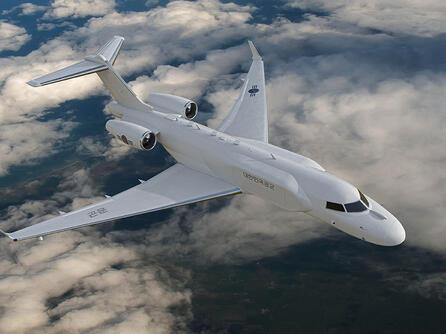
Press release | 10. 20. 2025
The Republic of Korea Selects L3Harris for Airborne Early Warning and Control Aircraft Program
L3Harris Technologies has received a contract to deliver modified Bombardier Global 6500 airborne early warning and control (AEW&C) aircraft to the Republic of Korea Air Force.