REDMOND, Wash., Sept. 24, 2023 — Aerojet Rocketdyne, an L3Harris Technologies (NYSE:LHX) company, played a key role in NASA’s successful delivery of the United States’ first asteroid sample to Earth. Aerojet Rocketdyne engines helped propel NASA’s OSIRIS-REx spacecraft throughout its mission - from its launch aboard an Atlas V rocket to asteroid surveillance, sample capture and return.
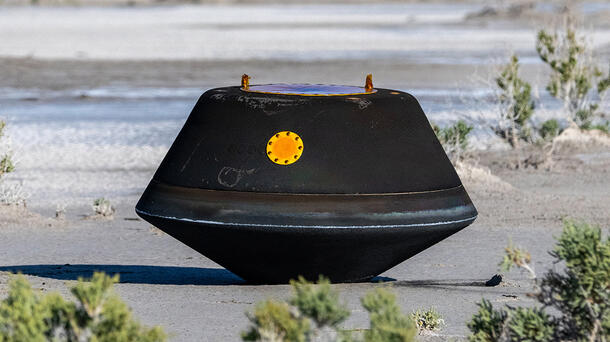
The OSIRIS-REx spacecraft, built by Lockheed Martin, returned its sample capsule containing material from asteroid Bennu to the Department of Defense’s Utah Test and Training Range. Scientists will study the rocks and dust collected in 2020 from the asteroid’s surface to learn about the formation of our solar system 4.5 billion years ago.
“Our propulsion was invaluable in propelling and steering the spacecraft, as well as returning it safely to Earth,” said Ross Niebergall, President, Aerojet Rocketdyne. “The successful completion of the mission highlights the reliability and performance of our in-space propulsion products.”
Launched atop United Launch Alliance’s Atlas V rocket on Sept. 8, 2016, Aerojet Rocketdyne provided an AJ-60A solid rocket motor, an RL10C-1 Centaur upper stage engine, twelve MR-106 reaction control thrusters on the Centaur upper stage and six pressurized Helium tanks. Aerojet Rocketdyne is the sole spacecraft propulsion provider, providing all 28 rocket engines onboard the OSIRIS-REx spacecraft, including four 60-lbf MR-107S, six 5-lbf MR-106L, 16 1-lbf MR-111G and two 0.02-lbf MR-401 engines.
OSIRIS-REx’s seven-year mission took the spacecraft over 1.4 billion miles, relying on a series of positioning maneuvers dependent on Aerojet Rocketdyne propulsion. NASA has extended the spacecraft’s mission, renaming it OSIRIS-APEX, and it will explore another asteroid, Apophis. In 2029, when Apophis passes near Earth, the spacecraft will use Aerojet Rocketdyne propulsion to keep pace with the asteroid and enter its orbit.
About L3Harris Technologies
L3Harris Technologies is the Trusted Disruptor for the global aerospace and defense industry. With customers’ mission-critical needs always in mind, our more than 50,000 employees deliver end-to-end technology solutions connecting the space, air, land, sea and cyber domains.
Forward-Looking Statements
This press release contains forward-looking statements that reflect management's current expectations, assumptions and estimates of future performance and economic conditions. Such statements are made in reliance upon the safe harbor provisions of Section 27A of the Securities Act of 1933 and Section 21E of the Securities Exchange Act of 1934. The company cautions investors that any forward-looking statements are subject to risks and uncertainties that may cause actual results and future trends to differ materially from those matters expressed in or implied by such forward-looking statements. Statements about future missions are forward-looking and involve risks and uncertainties. L3Harris disclaims any intention or obligation to update or revise any forward-looking statements, whether as a result of new information, future events, or otherwise.
# # #