
Despite its remoteness and lack of infrastructure, the Arctic is rapidly emerging as a contested operational domain. The opening of new shipping routes, increasing territorial disputes and renewed activity from peer Arctic nations seeking to enforce sovereignty and secure borders are driving this shift.
Strategic intelligence, surveillance and reconnaissance (ISR) is therefore critical to allied Arctic nations, because you cannot protect what you cannot see. This begins with enhancing Arctic domain awareness and equipping forces with purpose-built technologies that are hardened for extreme cold environments.
The Arctic Operational Challenge
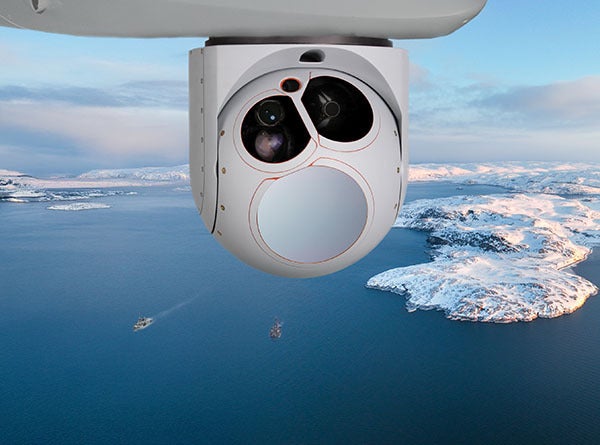
L3Harris WESCAM MX-Series EO/IR sensor systems enable persistent surveillance across all domains, including the Arctic.
Extreme cold degrades even routine operations. Mechanical components become sluggish, battery performance declines and precision optics face challenges related to focus stability, sensor sensitivity and overall system integrity.
Operators face similar challenges capturing usable imagery. Snow-covered environments offer limited contrast, dominated by whites, grays and pale blues. Whiteout conditions eliminate distinguishing features such as edges, shadows and texture, making object detection significantly more difficult.
For infrared (IR) systems, cold environments compress thermal contrast. Minimal temperature differences between targets and surroundings make detection more difficult. Snow and ice can also introduce reflections and false returns, while atmospheric effects scatter light and degrade image clarity. Together, these factors create a worst-case scenario for optical sensor systems operating across long-duration missions in remote environments with minimal support infrastructure.
In this cold, remote and often denied environment, missions must be executed with limited connectivity and degraded navigation. Sensor resilience, platform independence and the ability to operate without assured data links become mission critical.
Delivering Persistent ISR in Remote and Denied Environments
Arctic operations demand a range of mission capabilities, including maritime surveillance, sovereignty patrol, search and rescue, early warning, threat detection and counter-unmanned systems (c-UxS) operations.
The United States, Canada and allied nations have observed increased activity from non-NATO actors, including expanded infrastructure, refurbished airfields and growing military presence along Arctic coastlines.
Mission success requires more than basic imaging capability. Persistent ISR depends on long-range detection enabled by advanced optics and multi-axis stabilization, multi-sensor payloads capable of operating across all light conditions, reliable performance amidst cold, moisture and ice and secure, real-time dissemination of intelligence to distributed forces.
Multi-Spectral EO/IR for All-Weather Awareness
The Arctic’s operational demands require technologies designed specifically for these conditions. L3Harris Technologies’ WESCAM MX-Series systems are engineered to meet these challenges.
High-definition electro-optical (EO) sensors combined with powerful mid-wave infrared (MWIR) and short-wave infrared (SWIR) capabilities enable high-quality imaging in day, night and degraded visual environments. Wide and narrow fields of view, paired with long stand-off ranges, allow operators to detect and monitor targets while remaining beyond visual range.
During operation, a long-range ISR aircraft may detect a low-signature vessel navigating Arctic shipping lanes under low-visibility conditions. The sensor operator overrides the system’s automated sensor operation mode and transitions to SWIR and blended sensor views.
Against the low-contrast environment, a faint thermal signature emerges. Leveraging automatic target tracking, the operator locks onto the vessel and increases zoom, revealing critical identifying features. Within moments, the contact is classified as a potential threat and relayed to command for further action.
These capabilities are further enhanced through AI-enabled edge processing, supporting advanced object detection and multi-target tracking. Emerging capabilities enable detection of extremely small objects such as drones at minimal pixel thresholds, even down to 2x2 pixels, significantly improving identification confidence in complex environments.
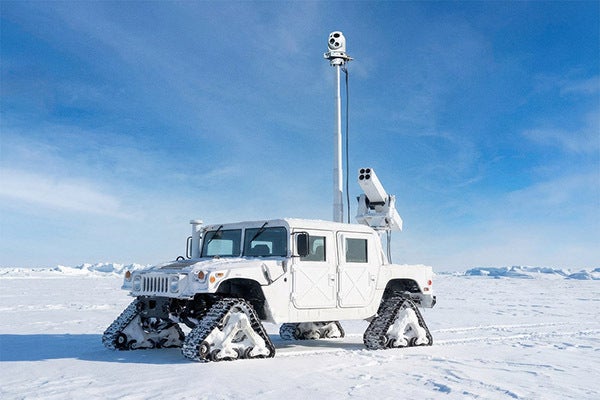
Advanced stabilization across both internal components and gimbal systems ensures image clarity despite platform vibration, high winds and turbulence. Additionally, WESCAM MX-Series systems provide increased geo-pointing accuracy by leveraging platform-provided GPS coordinates for precise target tracking, laser illumination and designation. The result is a ruggedized, combat-proven EO/IR system capable of sustained operation across manned and unmanned fixed-wing aircraft, rotary-wing platforms, UxS, ground vehicles and maritime vessels.
Whether conducting maritime surveillance, monitoring coastal infrastructure or tracking low-signature threats, WESCAM MX-Series systems can be tailored to meet mission-specific requirements.
Counter-UxS in the Arctic
Counter-UxS capabilities are increasingly critical in a battlespace defined by unmanned threats. WESCAM systems have demonstrated effectiveness in counter-UxS operations since 2023, supporting detection, identification and engagement workflows.
The proliferation of low-cost drones, even in Arctic regions, has increased the need for mobile, rapidly deployable counter-UxS solutions. These systems must operate from austere platforms, with minimal support, while maintaining reliability in extreme cold, high winds and low-light conditions.
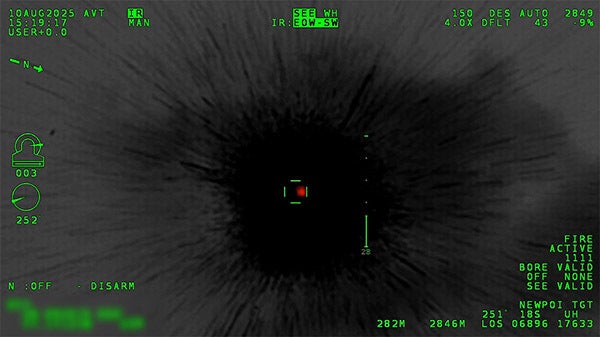
Current deployments see sensor operators take advantage of the passive nature of EO/IR systems, which do not emit signals, allowing persistent surveillance. With the available AI drone detection software engaged, the system automatically alerts an operator when a small object a few kilometers away meets the conditions of a potential drone threat, rather than a false target such as a bird. Zooming in and enabling the system’s infrared sensors, the sensor operator locks on to the object and readies the system for engagement.
L3Harris Technologies’ VAMPIRE system integrates WESCAM EO/IR sensors with AI-enabled detection and both kinetic and non-kinetic effectors, delivering a flexible and combat-proven solution for counter-UxS missions in denied and degraded environments, including in domains yet to see new waves of threats.
In the Arctic, where conditions degrade both systems and certainty, mission success depends on technologies that can deliver clarity when it matters.
See Far. See First. Act First.

