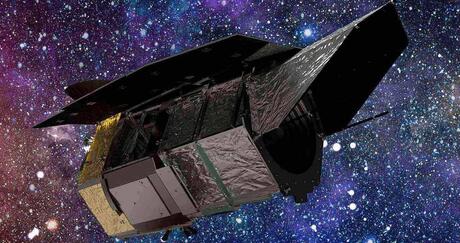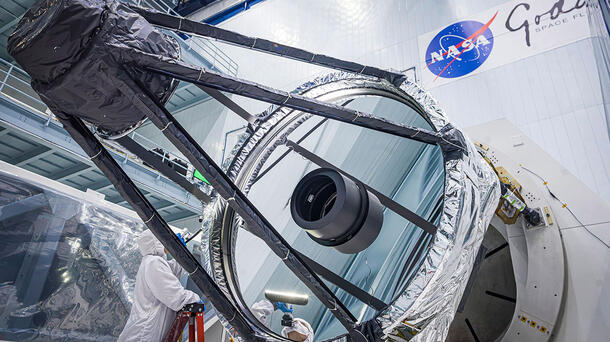
In just one month, NASA will launch one of the most ambitious space observatories ever built - the Nancy Grace Roman Space Telescope. Named after the woman who became NASA's first chief of astronomy in 1959, this revolutionary telescope will survey the cosmos 1,000 times faster than the Hubble Space Telescope, unveiling more than 100,000 distant worlds, tens of billions of stars and billions of galaxies in just its first five years.
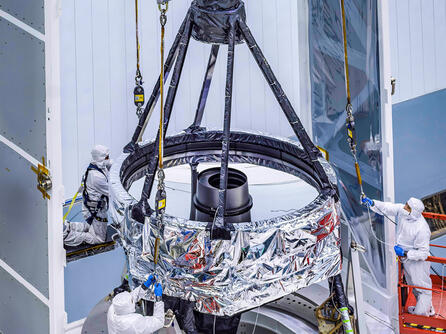
L3Harris Technologies has played a critical role in making this mission possible, designing and building the optical telescope assembly that serves as Roman's optical eye, along with communication systems, guidance sensors and electronic components that must perform flawlessly for years without possibility of repair.
Engineering for the Extreme
The Roman Space Telescope will operate at the second Lagrange point (L2), a gravitationally stable location roughly 1 million miles from Earth where the sun's and Earth's gravitational forces balance. Here, temperatures plunge and harsh radiation degrade sensitive electronics. For more than a decade, L3Harris has worked alongside NASA's Goddard Space Flight Center to develop systems capable of surviving this brutal environment.
Standing on the Shoulders of Giants
L3Harris has a proud heritage in space exploration spanning more than 60 years. The company assembled and tested the James Webb Space Telescope, which shares the same L2 orbital region Roman will occupy. L3Harris’ systems have traveled to Mars aboard the Perseverance and Curiosity rovers, provide critical capabilities for the GPS satellite constellation, support numerous Earth observation and national security missions and keep astronauts connected aboard the International Space Station and through the L3Harris-built Mission Astronaut Communication System for NASA’s Artemis II mission.
Each mission builds on lessons learned. Roman represents the culmination of decades of innovation in space-qualified systems, where every component must exceed expectations. The telescope's extraordinary speed and field of view make it ideal for studying dark energy, the mysterious force accelerating the universe's expansion, and for discovering exoplanets at an unprecedented scale.
Three Surveys to Rewrite Astronomy Textbooks
Roman will conduct three primary surveys that will transform our understanding of the universe. The first will look through the Milky Way's dense galactic center to discover a hundred thousand planets around other stars. The second will scan approximately 12% of the entire sky in under 18 months to measure how fast the universe is expanding, mapping dark matter with unprecedented precision. The third will study supernova explosions from up to eight billion years ago, tracing how the universe has evolved and shed light on dark energy's role in that evolution.
The mission will potentially identify worlds that could harbor life and its coronagraph instrument will image exoplanets by blocking their host stars' light, a critical technology paving the way for NASA's Habitable Worlds Observatory. Roman’s coronagraph is both a technology demonstrator and a science instrument, bridging the gap between current capabilities and the transformative imaging potential of the Habitable Worlds Observatory. These are transformational leaps in humankind’s ability to understand the universe's structure, composition and fate.
A Legacy Mission for Future Generations
For the engineers, technicians and scientists at L3Harris who have dedicated years to this program, launch day will mark both celebration and beginning. They've tested every component exhaustively, simulated every scenario and prepared for every contingency. Now, their technology will venture into the cosmos to answer fundamental questions about dark matter, dark energy and our place in the universe.
Space exploration pushes the boundaries of human knowledge and capability. It inspires the next generation of scientists and engineers. Missions like Roman are a reminder that when ambitious goals meet engineering excellence, there's no limit to what can be achieved.
The Nancy Grace Roman Space Telescope will change how humans see the universe. L3Harris technology makes that transformation possible.