
Millions of Miles from Home: How Perseverance Stays Connected

Every day on Mars, NASA’s Perseverance rover’s cameras are commanded to scan the horizon and capture images from a world no human has ever touched. On Earth, scientists are waiting to see what it found. Nothing about that exchange is simple.

More than 140 million miles of empty space stretch between Mars and Earth on average. Delivering those images and scientific data requires a carefully choreographed communications system operating across that vast distance. Perseverance cannot simply press “send,” nor does it beam its discoveries directly to Earth.

Instead, the rover transmits using Ultra-High Frequency (UHF) radio to Mars orbiters passing overhead. Acting as interplanetary couriers, those spacecraft sweep across the Martian sky at precisely timed intervals, receiving the rover’s images, telemetry and scientific measurements before relaying them onward across millions of miles to Earth.

Each transmission depends on split-second timing, precise alignment and a network functioning in near-perfect coordination. Signals hop from surface to orbiter to deep-space antennas with little margin for error. Invisible to the public, this relay-based communications architecture forms a quiet but essential bridge, keeping humanity connected to its robotic explorer on another world.

Built for Extremes

For this approach to work reliably, communications systems must perform under extreme conditions, including long distances, radiation exposure and limited contact opportunities. Consistency and reliability are critical, as even brief disruptions can affect mission planning and scientific operations. 

Meeting that requirement demands proven, flight-tested communications infrastructure. L3Harris has supported NASA’s Mars relay communications architecture for decades, contributing UHF communications technology that underpins today’s relay network. That continuity matters. While each Mars mission pursues new scientific objectives, the requirement for dependable communications between the Martian surface and Earth remains constant. 

For Perseverance, that reliability ensures images, telemetry and scientific measurements move consistently through the relay system and back to mission control, sustaining daily operations millions of miles from home. 

Mars rovers using L3Harris transmitters and transceivers. From left to right: Spirit, Opportunity, Curiosity and Perseverance

Mars rovers using L3Harris transmitters and transceivers. From left to right: Spirit, Opportunity, Curiosity and Perseverance.

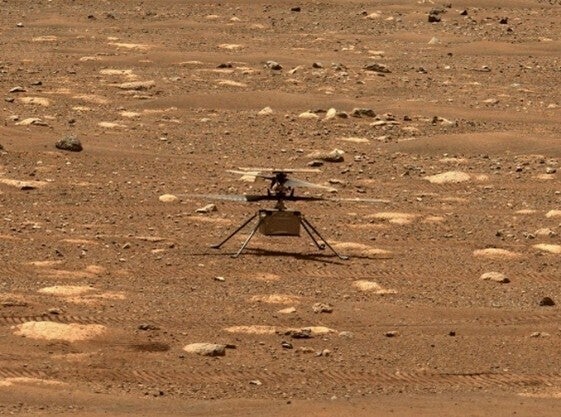
Mars Helicopter Ingenuity on Mars. Photo courtesy of NASA.

Photo courtesy of NASA. Mars Helicopter Ingenuity on Mars.

The Network Behind a Historic First

The relay communications architecture supporting Perseverance also played a role in one of the most significant milestones in planetary exploration: the first powered, controlled flight on another planet. 

NASA’s Ingenuity helicopter relied on communications to return flight data during its historic operations. The data was then transmitted to Mars orbiters, and then back to Earth. That same relay framework used for daily rover operations enabled engineers on Earth to receive performance data and assess each flight. 

Ingenuity’s success demonstrated how established communications infrastructure can support entirely new mission capabilities, expanding what is possible on the Martian surface.

Supporting Perseverance Through Proven Relay Systems

Among the technologies supporting NASA’s relay communications architecture are L3Harris’ Electra and Electra-Lite transceivers. These systems enable surface-to-orbiter communications as part of NASA’s established Mars relay network and have flown on a range of Mars missions, including Mars Reconnaissance Orbiter, Mars Odyssey and MAVEN.  

Electra-Lite supports Perseverance’s communications as part of the relay network, enabling the rover to transmit images, telemetry and scientific measurements to orbiting spacecraft for return to Earth. Designed for missions with strict size, weight and power constraints, Electra-Lite reflects the evolution of relay communications to support increasingly capable but compact exploration platforms. 

A Foundation that Supports Ongoing Exploration

As Perseverance continues exploring the Red Planet’s Jezero Crater region, its connection to Earth remains as critical as the science itself. The relay network operates largely unseen, yet it underpins every discovery transmitted home. 

Beyond relay communications, L3Harris has contributed sensing, power, propulsion and mission-support technologies across a wide range of NASA space programs. Drawing on decades of spaceflight experience, the company’s technologies support missions from launch to landing to surface operations. 

Across evolving scientific objectives and increasingly ambitious exploration goals, one requirement remains unchanged: reliable communication between Earth and spacecraft operating millions of miles away. For Perseverance and the missions that follow, that connection remains foundational. 

Resources

  • Mars Electra-lite UHF Transceiver Data Sheet

    Mars Electra-lite UHF Transceiver Data Sheet

Related News

Photo Credit: Northrop Grumman Corporation. Precision-guided munitions shown in production illustrate one of many operational systems benefiting from modernized M-Code GPS, supporting assured positioning, navigation and timing in contested environments.

Editorial | 03. 16. 2026

L3Harris Military GPS Receiver Deliveries Surpass 100,000 Units

Modernized GPS is strengthening operational assurance and signaling a new era of assured positioning, navigation and timing for U.S. and allied forces

Photo Credit: Northrop Grumman Corporation. Precision-guided munitions shown in production illustrate one of many operational systems benefiting from modernized M-Code GPS, supporting assured positioning, navigation and timing in contested environments.

Editorial | 03. 16. 2026

L3Harris Military GPS Receiver Deliveries Surpass 100,000 Units

Launched effect connects with other assets as it flies over water toward land

Press release | 03. 11. 2026

L3Harris and Shield AI Achieve Breakthrough in Autonomous Electronic Warfare

L3Harris' Red Wolf launched effects vehicle integrated on its Sky Warden aircraft

Editorial | 02. 09. 2026

L3Harris Red Wolf™ + Sky Warden™: Unmatched Flexibility for Kinetic Strike, EW, ISR and Support Missions

Artemis II

Editorial | 02. 02. 2026

Inside the Avionics That Make Artemis II Possible: How L3Harris Units Drive the Space Launch System

Navy’s Air Test and Evaluation Squadron 21 launch a Long Range Attack Missile

Press release | 01. 30. 2026

US Navy Selects L3Harris Red Wolf for Precision Attack Strike Munition Program