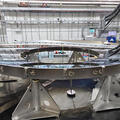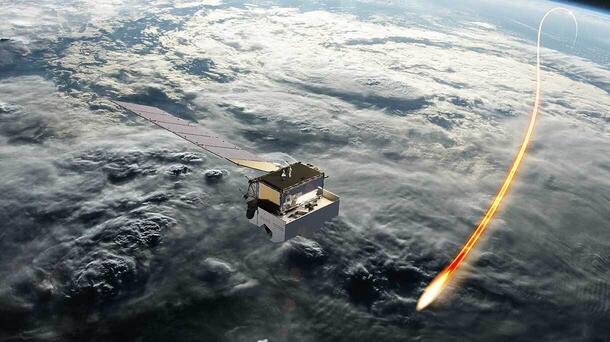
In support of national defense priorities defined by the Department of War, early this year L3Harris completed production of all 16 payloads for the Space Development Agency’s Tranche 1 Tracking Layer and, because of continuous production, moved into delivering Tranche 2 payloads.
These sophisticated payload systems, which leverage the company’s proven infrared sensor technology, are designed to provide detection, warning, and tracking of advanced hypersonic and ballistic missiles. Accelerating this work demonstrates the company’s ability to deliver advanced defense capabilities when the nation needs them most.
"We cannot wait 15 years to address this modern threat. The solution requires technology that can monitor emerging threats on a global scale, and the best way to do that is with space-based technology that are proven and ready now," said Paul Wloszek, Vice President and General Manager, Spectral Solutions, L3Harris. "L3Harris is supporting the SDA mission with infrared sensors that can detect, identify and target sophisticated threats in real time."
Addressing the Threat
Hypersonic missiles, weapons that maneuver unpredictably at five times the speed of sound, are operational around the world. America's current missile warning satellites, designed in an era of predictable ballistic trajectories, were not built to track them effectively.
To respond to this growing threat, the U.S. is betting on a radically faster approach, launching 158 missile tracking satellites in the time it once took to build four.
Traditional space acquisition follows a clear philosophy: get it right before launch. The SDA model inverts the equation: launch capability quickly, accept calculated risk, and improve with each "tranche" of satellites, deployed every two years.
As a result, the agency is on track to achieve global coverage in eight years—less than half the time of some legacy programs. L3Harris Technologies is supporting the SDA Tracking Layer across all existing tranches, with four missile tracking satellites already on orbit for Tranche 0 and another 52 satellites in development across Tranche 1, Tranche 2 and Tranche 3.
Gaining Experience and Momentum with Each Tranche
Critics question whether SDA is moving too fast, pointing to integration challenges, supply chain bottlenecks and on-orbit troubleshooting. The fact is, after initial launches revealed integration challenges, SDA adjusted — slowing its launch cadence, shifting ground operations to include industry-led systems, and addressing supply chain constraints.
Likewise, L3Harris and its industry partners are able to execute critical work on faster timelines with each subsequent tranche by leveraging lessons learned and implementing streamlined production processes. L3Harris recently invested $250 million to expand and modernize its production facilities in Indiana, Florida and Massachusetts to support the rapid development of next-generation missile defense capabilities, and with the capacity to scale production rapidly.
"We’ve made significant progress addressing supply chain constraints experienced on Tranche 1 to prepare for Tranche 2. We are demonstrating 10-15% improvements in supplier delivery schedules, which allow major assemblies such as payload systems and spacecraft buses to deliver in 22 months for Tranche 2 compared to 27 months on Tranche 1," Wloszek added.
What's at Stake
As the global threat from adversaries is moving faster than ever, Defense leadership is looking to industry to rapidly deliver capabilities that can preserve peace through strength. Next-generation missile warning and defense will require the most advanced capabilities from every part of our defense industrial base. We must be prepared to deliver.
The outcome matters beyond defense budgets and contractor awards. SDA success will establish a new template for rapid space capability development—one more aligned with commercial practices that could extend to communications, intelligence and navigation systems.
The question isn't whether the space industry will face more challenges—complex space architectures always do. The question is whether America can afford to build space systems the old way when adversaries are fielding new threats at unprecedented speed.
L3Harris and others across the industry are rising to the challenge. The satellites keep launching. Supply chains are maturing. On-orbit performance is being optimized. And every two years, a new tranche comes online, incorporating lessons learned and pushing our national defense capability forward.
Learn more about L3Harris’ missile warning, tracking and defense capabilities