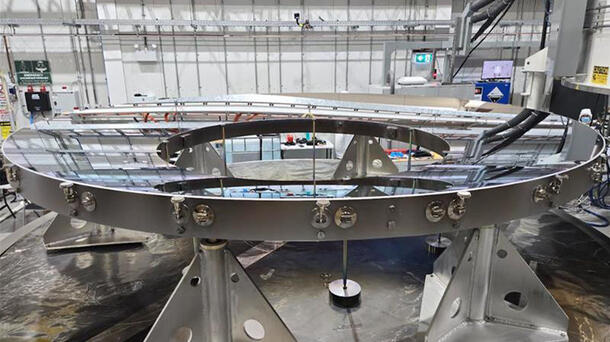
Working alongside our partner nation, Australia, L3Harris Technologies has completed a major mirror refurbishment for the U.S. Space Force’s Space Surveillance Telescope (SST). This critical milestone ensures one of the most advanced ground-based space surveillance systems remains fully mission-ready.
The achievement was recognized by the Mission Delta 2 commander, Col. Barry Croker, during his presentation at the 2025 Advanced Maui Optical and Space Surveillance Technologies Conference where he said, “Working with our partners in Western Australia, maintainers of the Space Surveillance Telescope have successfully completed their first primary mirror recoat, significantly improving our ability to detect small targets in GEO (geostationary Earth orbit).”
Located in the Southern Hemisphere, SST provides wide-area detection and tracking of objects in geosynchronous orbits, roughly 22,000 miles above Earth, ranging from operational satellites and debris to potential hazards and emerging threats. Completing this high-precision maintenance extends the telescope’s operational life and safeguards a capability the Space Force relies on to maintain space domain awareness as orbital congestion and adversary activities accelerate.
“SST is a cornerstone capability for protecting the nation’s space assets,” said Jeff Hanke, President, Space Systems, L3Harris. “This milestone ensures Space Force operators continue to receive the precise, reliable sensor performance they need to detect threats, avoid collisions and defend the space infrastructure our military, economy, and citizens depend on.”
Precision Engineering Where It Matters Most
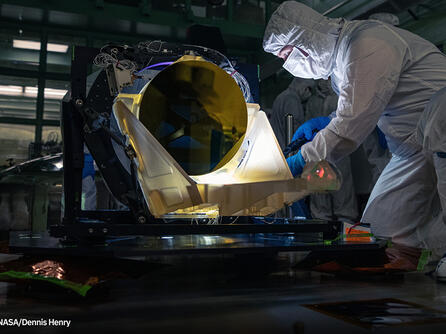
This upgrade required the careful removal, restoration, and enhancement of SST’s primary and tertiary mirrors – the optical core that enables long-range detection and accurate object tracking. L3Harris engineers repaired and strengthened critical connection points, improving mirror stability and performance in an austere operating environment.
The primary mirror underwent a full refurbishment, including stripping, cleaning and recoating using a Vacuum Deposition System custom-built for SST. The tertiary mirror received specialized cleaning to meet enhanced coating standards, along with structural repairs to its support hardware. Together, these upgrades restore and improve the telescope’s optical performance, ensuring continued accuracy and reliability.
A Strategic Advantage for the Space Force and Allies
Relocated from White Sands Missile Range, New Mexico, to Australia in 2017 and operational since 2022, SST plays a key role in a U.S.- Australia space situational awareness partnership supporting the U.S., its allies and global partners.
Unlike space-based sensors, which degrade permanently once on orbit, ground-based systems like SST can be upgraded and restored, providing a long-term strategic advantage as space becomes an increasingly contested warfighting domain.
With more than 50 years of experience delivering advanced electro-optical systems, L3Harris brings unmatched heritage to the nation’s most demanding space missions. L3Harris optics have flown on more than 200 orbital missions, delivering proven performance and reliability when failure is not an option.