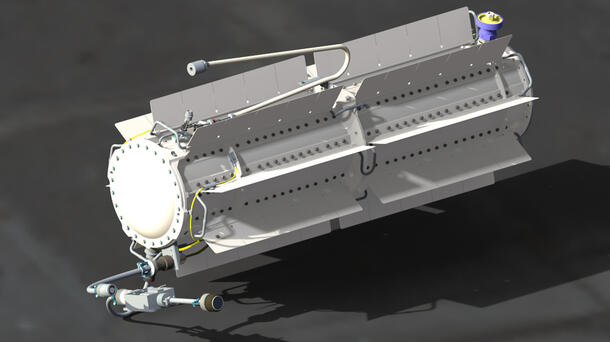
L3Harris Technologies has finalized the design of a next-generation nuclear-based power source for future NASA deep space missions, marking a crucial advancement in spacecraft power technology.
The Next-Generation Radioisotope Thermoelectric Generator (Next Gen RTG) cleared its critical design review (CDR) on April 2, 2026, paving the way for a new era of outer solar system exploration.
“Passing the CDR is an important milestone because it validates that our design meets all the technical requirements and can be manufactured,” said Bill Sack, General Manager, RocketWorks and Power Systems at L3Harris. “It also demonstrates we've successfully re-established this critical capability after years of limited production.”
Flight units could power NASA deep space probes starting in the early 2030s, including a proposed Uranus orbiter that would use two Next Gen RTGs for power and for keeping its temperature-sensitive components warm enough to operate in the frigid environment of the outer solar system. This dual-purpose capability makes RTGs indispensable for such missions.
What is the Next Gen RTG?
RTGs convert heat from the radioactive decay of plutonium-238 into electricity. Necessary for probes that are too far from the Sun to rely on solar power, they have been in use for 60 years. Early versions continue to supply power to NASA’s twin Voyager probes, which were launched in 1977 and are now traveling in interstellar space.
The Next Gen RTG is an evolution of the general-purpose heat source RTGs that supplied power to NASA’s Cassini Saturn orbiter and, more recently, New Horizons probe, which carried out a Pluto flyby in 2015 and is now exploring the frozen wonders of the Kuiper Belt. Unlike the L3Harris-built Multi-Mission RTGs currently powering NASA's Curiosity and Perseverance Mars rovers, the Next Gen RTGs are optimized for spacecraft operating in the vacuum of space rather than on the surface of a planet.
This distinction is critical for future missions. The vacuum-optimized design allows for more efficient heat rejection and power generation in the deep space environment where missions like the Uranus orbiter will operate. As a result, the Next Gen RTG offers a higher power output at approximately the same weight as the Multi-Mission RTG. With the capability to generate about 250 watts of power at the beginning of its life, each Next Gen RTG will provide reliable, long-duration power for spacecraft exploring the outer reaches of our solar system.
“The Next Gen RTG represents a significant leap forward in efficiency," added Sack. "We're delivering more power in the same mass envelope, which is critical when every kilogram matters for deep space missions."
Why the Next Gen RTG Matters
The availability of Next Gen RTGs opens the door to a range of ambitious missions that have been on NASA's wish list. Beyond the Uranus orbiter, these power systems could enable:
- Extended missions to Neptune and its moon, Triton
- Kuiper Belt object explorers that can go beyond the range of the New Horizons spacecraft
- Long-duration missions to the outer planets' moons
- Interstellar precursor missions that push even farther than the Voyager 1 and Voyager 2
Restarting Production
The U.S. Department of Energy’s Idaho National Laboratory tapped L3Harris in 2021 to re-establish the key technologies from the heritage system and update the design in response to growing interest in new deep space missions. The contract is expected to end in 2027 with a production readiness review to verify that the next-generation system can be built using the materials and components that have been re-established.
“We are proving we can do it again," said Leo Gard, Space Propulsion & Power Systems Program Manager at L3Harris. “While we didn't build the original generators, we've successfully reconstructed incomplete documentation and identified modern equivalents for obsolete components through creative problem-solving."
A Collaborative Effort
As prime contractor on the Next Gen RTG program, L3Harris is responsible for the main structure and overall system integration. Teledyne Energy Systems Inc. of Hunt Valley, Maryland, makes the thermoelectric couples that convert heat to electricity, while BAE Systems Space and Mission Systems in Boulder, Colorado, is responsible for insulation.
About Idaho National Laboratory
Battelle Energy Alliance manages INL for the U.S. Department of Energy’s Office of Nuclear Energy. INL is the nation’s center for nuclear energy research and development, and also performs research in each of DOE’s strategic goal areas: energy, national security, science and the environment.