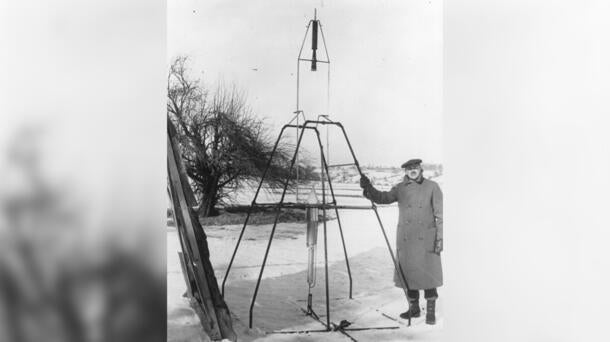
One hundred years ago, Robert Goddard’s first liquid-fueled rocket flight demonstrated that controlled, high-energy propulsion was achievable, launching the modern era of rocketry. Today, L3Harris Technologies applies that same spirit of innovation to its propulsion, avionics and communications systems to make advanced space missions possible.
Goddard’s pioneering rocket didn’t fly very high, far or fast on that snowy Massachusetts day in March 1926. But it laid the propulsive foundation for Space Age achievement, culminating in the astronaut landings on the moon from 1969 to 1972. Few companies have built on that foundation as extensively as L3Harris, whose systems powered critical phases of the Apollo missions, supported every launch throughout the space shuttle era and helped send Voyager 1 and Voyager 2 to interstellar space.
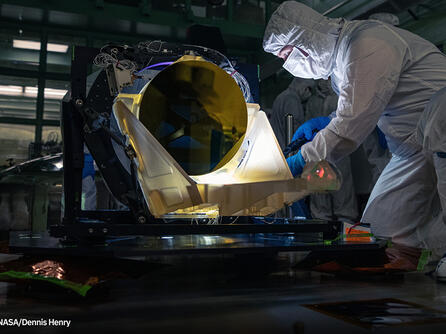
As modern rocketry enters its second century, mission demands are growing even more complex and ambitious – from extended-duration operations and precise maneuvering to resilience in contested and extreme environments. L3Harris is meeting these challenges with its broad propulsion portfolio, reliable avionics and space communications systems to ensure mission success across every phase of flight.
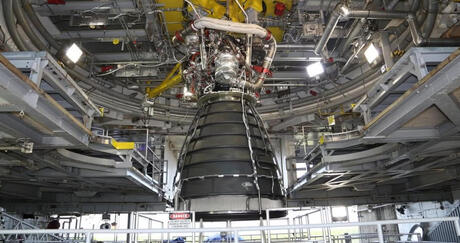
For example, as NASA prepares to return astronauts to the moon through its Artemis campaign, L3Harris is once again providing the necessary push – ranging from the RS-25 and RL10 engines on the Space Launch System (SLS) to smaller thrusters that enable precise spacecraft maneuvering and orientation. L3Harris’ avionics and electronic systems further support human exploration, while the company’s development of space nuclear power and propulsion systems promises to enable even the most ambitious solar system exploration campaigns.
One L3Harris system, the liquid-hydrogen fueled RL10, has been the nation’s premier, high performance upper-stage rocket engine for more than 60 years, with more than 530 engines flown in space to help deliver military, civil and commercial satellites into Earth orbit and send spacecraft to explore every planet in our solar system. The gold standard for reliability and versatility, the RL10 has powered a diverse array of launch vehicles, including the Saturn I, and the Delta, Atlas and Titan rocket families. Several major upgrades over the years have ensured a continued role for the RL10 on the SLS, Atlas V and Vulcan rockets that are flying today.
Capable of multiple restarts and variable thrust levels, the RL10 was a trailblazer for reusable rockets. Four RL10s powered the U.S. government’s reusable Delta Clipper Experimental (DC-X) rocket, which flew 12 times within the atmosphere during the 1990s.
While liquid propulsion remains essential for launch and high-energy maneuvers, future missions will increasingly depend on sustained, energy-efficient propulsion in space. L3Harris is leading the way in high-efficiency electric propulsion, having built the thrusters for NASA’s lunar-orbiting Gateway station, which will be used to stage trips to and from the lunar surface. The Gateway’s three 12-kilowatt Advanced Electric Propulsion System (AEPS) thrusters – the largest ever flown in space – will rely on power collected by onboard solar arrays. However, future versions will draw electricity from nuclear reactors, providing energy-efficient cargo transport to Mars while enabling long-duration robotic exploration missions to the outer planets.
L3Harris has a long history in space-based nuclear power, having built the only U.S. reactor flown in space, as well as the plutonium-fueled generators aboard the Mars Curiosity and Perseverance rovers. The company will leverage that experience to develop the Fission Surface Power (FSP) system, which NASA has prioritized to provide electricity for sustained operations on the moon and, later, Mars.
In addition to powering electric thrusters, L3Harris’ nuclear power and propulsion technology provides a basis for nuclear thermal propulsion (NTP) systems that promise to dramatically reduce astronaut transit times to Mars, reducing their exposure to hazardous radiation. L3Harris has been laying the groundwork for NTP to fulfill the nation’s ambitions in space, pairing advanced propulsion concepts with the avionics and communications architectures required for complex, long-duration missions far from Earth.
In the century since Robert Goddard offered a glimpse of what was possible in space, L3Harris helped turn that vision into reality. From enabling NASA's return to the moon to ensuring resilient space operations, L3Harris provides the propulsion, avionics and communication systems that keep the nation's most critical space missions on course. Robert Goddard's 1926 flight may have lasted just 2.5 seconds and traveled only 184 feet, but it opened a pathway to the stars.