Orion Meets SLS: L3Harris Technology Ready to go to the Moon

NASA’s Artemis II mission is one step closer to launch after the Orion spacecraft was stacked atop NASA’s Space Launch System (SLS) rocket inside the Vehicle Assembly Building at Kennedy Space Center. This milestone marks the first time the full Artemis II stack has come together.

The Orion spacecraft is designed to take crews to deep space destinations and return them safely to Earth. Four astronauts – Commander Reid Wiseman, Pilot Victor Glover and Mission Specialists Christina Koch and Jeremy Hansen – will call Orion home during their 10-day Artemis II mission, which will send them on a journey around the moon and back.

L3Harris plays a critical role in Orion’s capabilities, providing 22 engines and motors that enable precise maneuvers in space; the audio system that connects astronauts to each other, mission control and the world; as well as composite overwrapped pressure vessels that support the operation of the spacecraft during its journey. These technologies are essential to Orion’s ability to carry astronauts farther into space for longer periods of time. 

“This is the first time since 1972 that we've assembled a rocket and spacecraft that will carry humans to the moon's vicinity,” said Kristin Houston, President, Space Propulsion and Power Systems, Aerojet Rocketdyne, L3Harris. “This is an exciting moment for the Artemis II mission, and the spacecraft’s name ‘Integrity’ is fitting, as it embodies the trust, precision and resilience required to make this mission a success.”

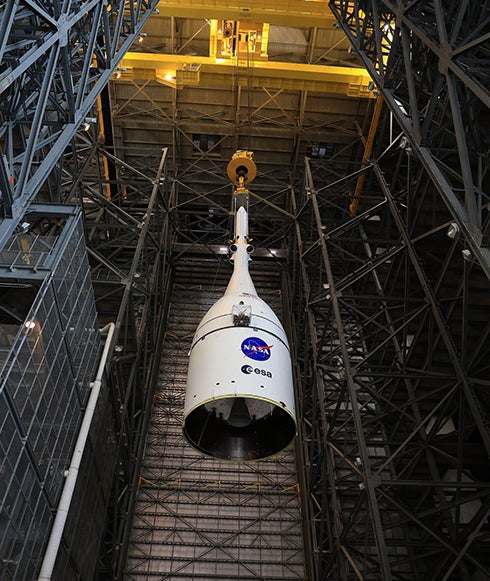
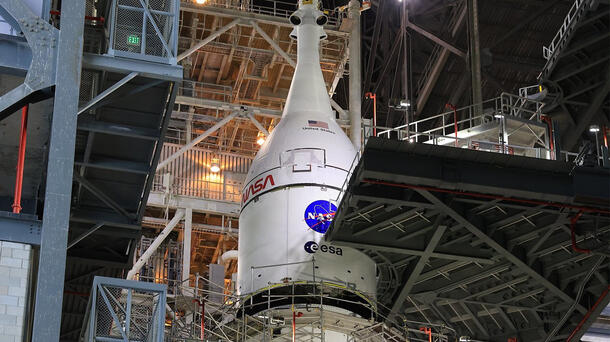
The Orion spacecraft for NASA’s Artemis II mission, fully assembled with its launch abort system, is lifted ontop of the Space Launch System (SLS) rocket in High Bay 3 of the Vehicle Assembly Building at Kennedy Space Center in Florida.

The Orion spacecraft for NASA’s Artemis II mission, fully assembled with its launch abort system, is lifted ontop of the Space Launch System (SLS) rocket in High Bay 3 of the Vehicle Assembly Building at Kennedy Space Center in Florida. 

Preparing for Launch

For the next several months, the Artemis II vehicle will undergo rigorous integrated testing to ensure all systems work seamlessly together. These tests will prepare the spacecraft and rocket for their ultimate mission: carrying astronauts around the moon and back.

“With Orion now securely on top of the core stage, the Artemis II stack is a powerful symbol of our nation’s commitment to exploration and pushing the boundaries of what’s possible – an especially fitting milestone as we prepare to celebrate the 250th anniversary of America’s founding next year,” added Houston. “Stacking Orion onto the SLS rocket is not just a technical milestone, it represents the incredible teamwork and innovation that are driving the future of human space exploration.”

Related News

NASA’s Space Launch System rocket carrying the Orion spacecraft launches on the Artemis I flight test, Wednesday, Nov. 16, 2022, from Launch Complex 39B at NASA’s Kennedy Space Center in Florida. Photo credit: NASA.

Editorial | 01. 07. 2026

For L3Harris, the Action Starts Six Seconds Before Artemis II Lifts Off

The RS-25 engines ensure a safe and successful start to NASA’s historic Artemis II crewed mission to the Moon.

NASA’s Space Launch System rocket carrying the Orion spacecraft launches on the Artemis I flight test, Wednesday, Nov. 16, 2022, from Launch Complex 39B at NASA’s Kennedy Space Center in Florida. Photo credit: NASA.

Editorial | 01. 07. 2026

For L3Harris, the Action Starts Six Seconds Before Artemis II Lifts Off

Nexus Background Stealth

Press release | 01. 05. 2026

L3Harris to Sell Majority Stake in Space Propulsion & Power Business to AE Industrial Partners

Aerojet Rocketdyne and Kratos Successfully Hot-fire Zeus 2 Advanced Large Solid Rocket Motor

Press release | 12. 23. 2025

L3Harris Receives Letter of Intent from Kratos Defense for Production of Large Hypersonic Solid Rocket Motors

L3Harris technology for the SDA Tranche 3 Tracking Layer program will provide infrared sensing, advanced on-orbit data processing and real-time detection of advanced hypersonic and ballistic missile threats

Press release | 12. 19. 2025

Space Development Agency Awards L3Harris $843 Million Contract for Tracking Layer Satellites

Rear view of an L3Harris Red Wolf vehicle, mounted to the pylon of an AH-1Z Viper helicopter during a successful low-altitude test firing

Editorial | 12. 19. 2025

US Marine Corps Increases Affordable Mass Demonstrations with Successful Red Wolf™ Low-Altitude Live Fire