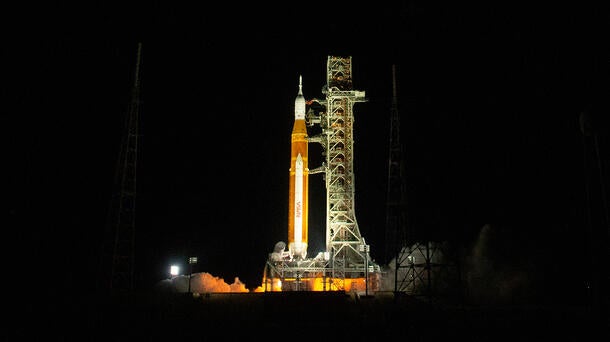
Few events rival the suspense of a rocket launch, and the final countdown to Artemis II, the first crewed flight of NASA’s Space Launch System (SLS) rocket, is sure to captivate the world.
Observers will note the hush falling over the crowd during the final 10 seconds before liftoff. But in the L3Harris Rocket Operations Support Center (ROSC) in Canoga Park, California, directly linked to NASA’s mission control, things literally heat up six seconds before liftoff, when the vehicle’s four RS-25 engines ignite one by one.
By the time the vehicle’s two solid rocket boosters ignite at T-minus-zero, its liquid-fueled RS-25 engines are running at full throttle, providing a brief opportunity to check and make sure all are – to use a metaphor from a different kind of engine – “firing on all cylinders.” If something appears amiss, controllers can abort the mission, right up to the moment the solid boosters light, after which there is no turning back.
From her vantage point 3,000 miles away from NASA’s SLS launch site at Kennedy Space Center in Florida, Helen Lewin, L3Harris' RS-25 Launch Support Lead, has spent years monitoring the RS-25 start sequence. She held a similar role supporting launches of NASA’s Space Shuttle, which relied on three RS-25 engines, then known as the Space Shuttle Main Engine.
“The main thing we’re looking for is that the fuel and oxidizer turbopumps are spinning up at the rates we expect,” Lewin said. “The whole focus is on making sure we have good combustion in the main combustion chamber of each engine.”
On SLS, engine No. 3 ignites first, followed by No. 1 on the diagonally opposite side of the four-engine cluster. Then comes engine No. 4, followed by No. 2, again on the opposite side. The order prevents the thrust of a single engine from tilting the vehicle too far in the opposite direction.
After engine ignition, each engine powers up to 100% of rated thrust in a sequence that takes approximately five seconds. This leaves about one second of ”main stage,” after which all four engines throttle up to 109% as the solid rocket boosters ignite, and the entire rocket lifts off the launchpad.
The first four SLS missions are using Space Shuttle Main Engines upgraded with modern flight computers. In fact, the engines on Artemis II previously flew 22 times during the Space Shuttle program. L3Harris is building brand-new RS-25 engines for SLS missions beginning with Artemis V.
Although people oversee the process, the flight computers – which monitor turbopump speed, internal pressure, temperature and vibration – are designed to respond instantly to conditions that don’t meet safety criteria, ensuring the launch can be safely shut down if necessary.
On-the-pad shutdowns happened a handful of times in the early days of the Space Shuttle program, due primarily to faulty sensor readings, Lewin said.
“We never had a launch pad shutdown because an engine failed to ignite or power up correctly,” Lewin added. “Our guiding philosophy is we can always launch another day.”
The historical significance of the Artemis II mission isn’t lost on those who monitor the launch in the ROSC, but once they take their places about 10 hours before launch, their focus narrows.
“In the moment, we’re very much focused on doing our jobs — watching squiggly lines crawl across our screens — and those lines tell us the real story of what’s happening inside the engines,” said Lewin.
Still, the significance of the mission, which will send four astronauts to the vicinity of the moon for the first time in more than 50 years, is impossible to ignore.
“This is a historic moment, the beginning of a new phase of space exploration,” said Lewin. “It’s very exciting to be part of that.”
She added, “I’ve had the privilege of meeting the astronauts who will be relying on our engines to launch them safely to the moon, so it’s very personal to me.”