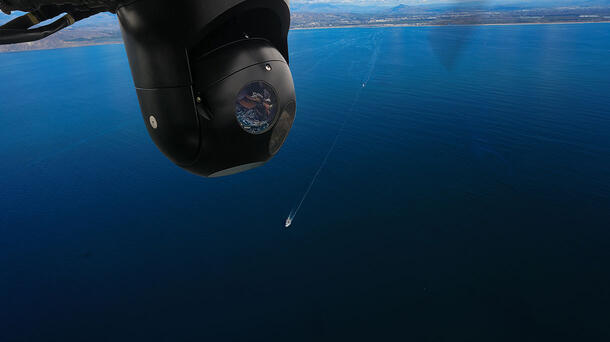
At 0200, 80 nautical miles offshore, the ocean looks empty. It isn’t. A single fast-moving vessel with a low profile and minimal lighting cuts across the surface. The sea state is rising. Visibility is degrading. A reconnaissance aircraft is moving fast and the sensor operator is already managing comms traffic, airspace deconfliction and multiple taskings from higher command. In today’s environment, ISR missions are won or lost at the point of detection.
For decades, electro-optical/infrared (EO/IR) performance defined the mission: sharper imagery, longer range and better stabilization. But today’s operational environment has changed. Sensors don’t just need to see farther, they need to find faster. The vessel is small, moving unpredictably and blending into a cluttered maritime background. Missing it early means losing it entirely.
The Operator Bottleneck
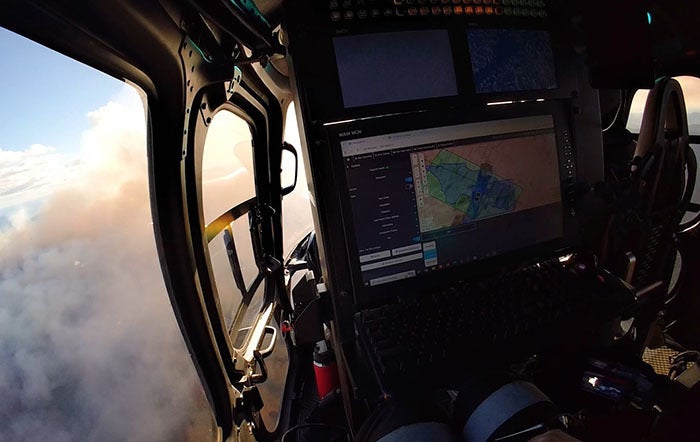
Speak to any experienced sensor operator and the constraint is immediate and human. Missions are comprised of hours of manual scanning, managing multiple feeds and addressing competing priorities. Fatigue sets in long before the mission ends.
Even with the most advanced EO/IR systems, the process is still largely the same: the operator searches, cues, tracks and confirms. Scale the mission, increase the number of sensors and compress the timeline and that workload becomes unsustainable for smaller crews. The risk is not that the sensor cannot see the target. The risk is that no one sees it in time.
This is where many “AI-enabled” ISR solutions fall short. They process. They enhance. They analyze after the fact. But they don’t solve the core problem: who is doing the searching?
Shifting the Burden: Autonomy at the Sensor Edge
L3Harris’ WESCAM MX-Series EO/IR systems, integrated with Overwatch Imaging’s Automated Sensor Operator (ASO), change that dynamic at its source. Instead of waiting for the operator to find and cue a target, the sensor itself is continuously working the environment. It scans, detects, classifies and initiates tracks in real time at the point of collection.
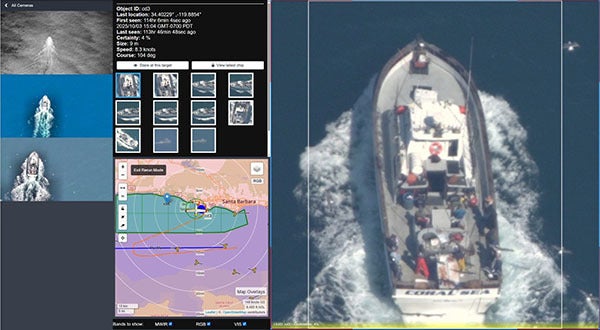
The vessel is identified as a contact while it is still outside the operator’s immediate attention. A track is established early, before the geometry becomes complex or the target disappears into sea clutter. From the operator’s perspective, the shift is immediate. The sensor becomes a second set of eyes that never fatigues and never looks away.
This takes the independent nature of state-of-the-art autonomous platforms to new heights.
As one operator puts it succinctly: “If you don’t automate the sensor finding the high-value objects you need to find, the platform isn’t truly autonomous. Teams need to ask themselves – your platform may operate autonomously, but does your sensor?”
Not All “AI at the Edge” Is Equal
There’s no shortage of EO/IR + AI pairings entering the market and many fall into one of three categories:
Post-Mission Analytics
High-quality imagery is collected, downlinked and processed later. This is valuable for intelligence exploitation, but irrelevant for time-sensitive missions where detection latency equals lost opportunity.
Ground-Dependent AI
Algorithms run offboard, requiring persistent, high-bandwidth data links. Effective in permissive environments, but fragile in contested or degraded communications conditions.
Narrow, Pre-Configured Detection Models
Solutions are tuned for specific targets or environments, often requiring reconfiguration or retraining to adapt to new mission sets, limiting flexibility in dynamic operations.
The difference with L3Harris’ WESCAM MX-Series and Overwatch Imaging’s ASO is architectural. Processing happens onboard, not downstream. Detection is continuous, not triggered. Mission sets are adaptable, not fixed. It’s a next evolution of AI embedded into the sensor, instead of an additional layer. ASO analyzes every pixel within the sensor’s field of regard in real time, systematically searching wide areas with a level of consistency no human operator can sustain over long durations. The system maintains awareness of the vessel even as conditions degrade and operator attention is pulled elsewhere.
Working the Mission, Not the Sensor
In a typical multi-sensor aircraft, crew capacity dictates sensor utilization. One system is actively tasked; others are deprioritized. This happens not because they lack capability or skill, but because air crews have limited bandwidth to operate them all effectively.
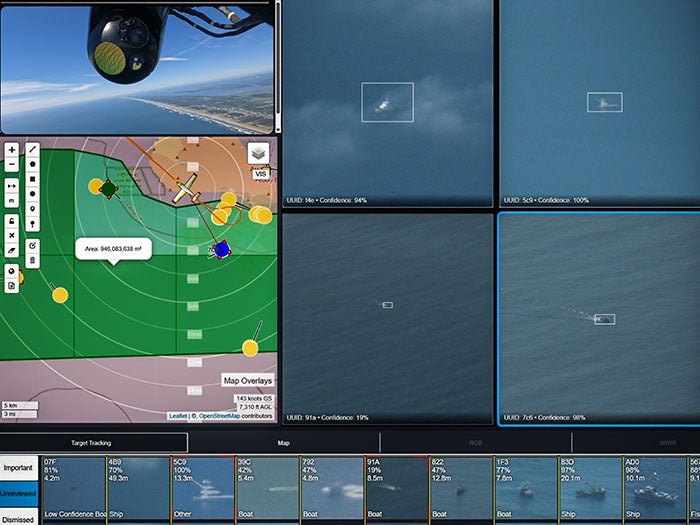
With ASO-enabled WESCAM MX-Series systems, that constraint is removed. Multiple sensors can conduct simultaneous, autonomous search operations, each maintaining its own detections and tracks while feeding the operator prioritized insights. The result is a shift in how missions can be executed. Units can expand their effective coverage area with a higher probability of detection through systematic, persistent search without additional sorties. When teams need to engage, there is also faster handoff between autonomous and manual control.
While one sensor maintains track on the vessel, another continues searching the broader area for additional contacts or patterns of activity. The operator is no longer forced to choose between coverage and focus.
From the cockpit or mission console, the difference is clear: Instead of managing sensors, the operator manages the mission. Instead of scanning empty space, they are making decisions on validated detections. Instead of reacting late, they are acting early. They are embodying the WESCAM MX-Series ethos: See First. Act First.
Decision Advantage in Denied Environments
In contested environments, bandwidth is never guaranteed. Jamming, latency or simple network saturation can disrupt the flow of ISR data back to ground stations where many AI-driven solutions rely on processing to occur.
That delay introduces risk. A degraded link means losing the ability to confirm, classify or share the vessel’s position in time to act.
WESCAM MX-Series sensors with ASO eliminate that dependency. Detection, classification and tracking occur locally, onboard the platform, ensuring that actionable intelligence is generated regardless of connectivity. Even in a communications-denied environment, the operator retains full awareness of what’s happening within the sensor’s field of regard. The timeline from sensor to decision-maker collapses because they are one and the same.
Mission Agility Without Reset
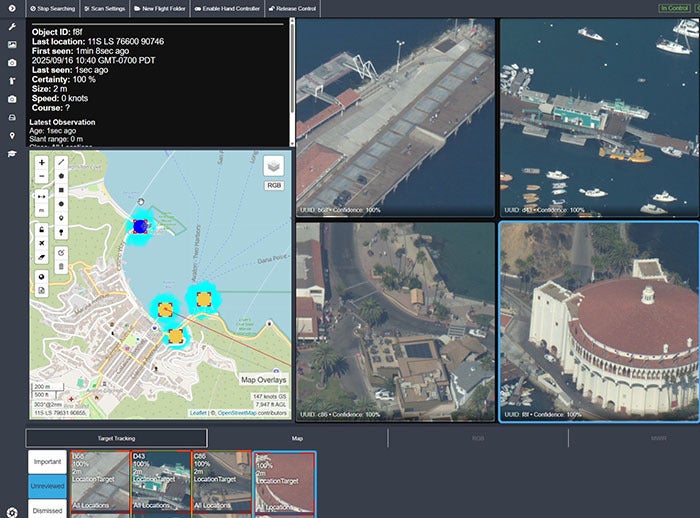
Real-world missions don’t stay neatly defined. A maritime surveillance tasking can shift to overland tracking. A border patrol can pivot into search and rescue. A wildfire overwatch mission can suddenly require infrastructure assessment.
Most systems introduce friction at these transition points with new configurations, new tasking workflows and new delays. With WESCAM MX-Series and ASO, that friction disappears. The same sensor, the same sortie, the same workflow all adapting in real time to changing mission demands without the need for costly reconfiguration, downtime or loss of coverage.
The system maintaining maritime track can be re-tasked immediately if the situation evolves, without interrupting ongoing detection or losing context.
Proven in the Conditions That Matter
The impact of sensor-level autonomy is most visible under operational pressure. In operational maritime environments, ASO-enabled WESCAM MX-Series systems have demonstrated reliable detection performance across a wide operating envelope, spanning altitudes from low-level flight to 30,000 feet, platform speeds exceeding 200 knots and ranges extended beyond 130 nautical miles.
As one classified operator noted:
“Overwatch Imaging’s ASO proved to be an exceptionally capable maritime surveillance tool, consistently detecting across a wide operating envelope, detecting vessels ranging from 7 meters to well beyond 200+ meters. Its ability to rapidly acquire targets and deliver actionable awareness with minimal operator workload highlights both its effectiveness and efficiency.”
For operators, that translates into something tangible such as earlier detection of low-signature targets, sustained tracking without constant manual input and reduced cognitive load over long-duration missions. The vessel is found early, tracked consistently and never lost.
Extending Capability Without Replacing Fleets
Perhaps the most practical advantage is how this capability is delivered. Through software integration, existing WESCAM MX-Series sensors can be upgraded to incorporate ASO, transforming current fleets into autonomy-enabled ISR assets without new airframes, new sensors or major system overhauls. This allows operators to scale capability now while protecting long-term capability and platform investments.
The New Role of the Sensor
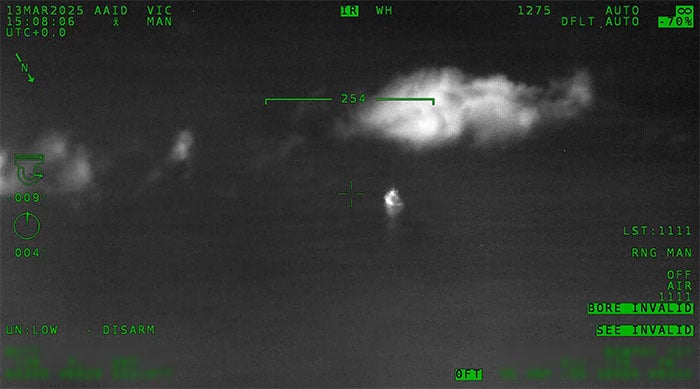
The shift from payload to platform isn’t conceptual. It’s operational. An EO/IR system is no longer just a means of collecting imagery. It is an active contributor to mission execution. Searching, detecting, tracking and informing — and doing so continuously, at the edge, without adding to operator burden.
The vessel is detected early, tracked through challenging conditions and maintained as a known contact despite competing demands and degraded visibility. The operator is not overwhelmed. The mission does not fall behind the timeline.
In modern ISR, the advantage doesn’t go to the platform that flies the longest or the sensor that sees the farthest. It goes to the team that finds first—and acts fastest.
With WESCAM MX-Series and Overwatch Imaging’s ASO, that advantage starts at the sensor.


