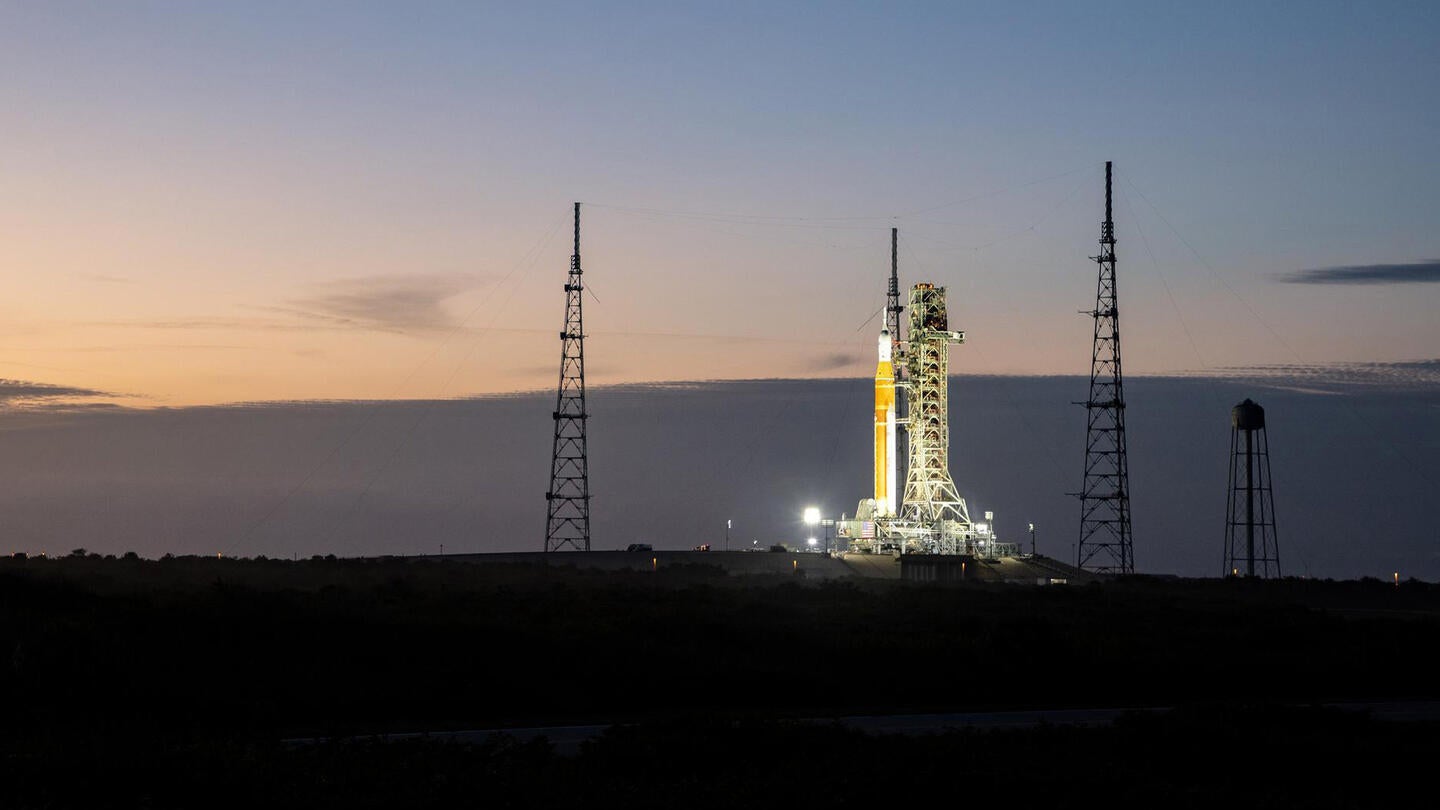
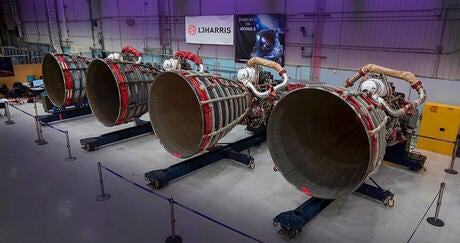
“Completing WDR is a major step to validate all the systems on the Artemis II stack, including the RS-25 engines,” says Bill Muddle, Lead RS-25 Field Engineer, L3Harris. “The WDR is the final ‘test like you fly’ exercise, validating that all systems are working properly and ready to go for launch.”
The WDR will take place ahead of the upcoming Artemis II mission, which is the first astronaut-carrying flight of the SLS and Orion spacecraft. The mission will take its four-person crew on a journey around the far side of the moon and back in preparation for a return of astronauts to the lunar surface in the coming years.
For the launch and WDR, the teams will be in place well before the fuel starts flowing in earnest. At T-19 hours, for example, the engine controllers are powered up to perform a few additional checkouts to make sure they are working properly.
Once the systems are verified, the teams move on to a series of four purges, the first two of which use heated nitrogen gas to flush any moisture that might have built up in the engines and associated plumbing. This ensures they operate effectively and safely throughout the mission. Purge 3 begins a slow flow of liquid hydrogen and liquid oxygen from the ground spherical tanks to the engines, effectively beginning the chill-down process.
“We chill down the lines from the spheres, then we start chilling the vehicle,” Muddle says. “The fueling is done in phases, starting off slowly to fill the lower part of the core stage propellant tanks. The launch team then opens the spigots for fast fill, during which the fuel flows at a rate of about 1,300 gallons per minute for liquid oxygen and about 8,000 gallons per minute for liquid hydrogen.”
Once the tanks are nearly full, the flow is slowed once more until they reach what is called “stable replenishment,” at which point the tanks are topped off to keep pace with the loss of the cryogenic propellants due to boiloff. Loading of the SLS second stage, or Interim Cryogenic Propulsion Stage, begins at a point when the core stage is partially loaded, so that both stages reach stable replenishment at approximately the same time.
“Orchestrating the propellant filling process so that all four tanks reach stable replenishment requires some real rocket science,” Muddle adds. “Data gleaned from the WDR will be used to make any necessary adjustments prior to launch.”
At T-3 minutes and 50 seconds, the core stage APUs are started, paving the way for the fourth purge sequence when the RS-25 engines change from pneumatic to hydraulic control for flight.
The WDR takes the countdown all the way to T-30 seconds when control of the vehicle transitions from the ground launch sequencer to the automated launch sequencer, stopping just shy of the T-6 second mark when the engines would light one by one during an actual launch.
From his vantage point in the Launch Control Center’s Firing Room 4, Muddle will be in the thick of the action during the WDR and the actual launch.
“I’m excited to play a role in returning humans back to the lunar vicinity for the first time in 50 years,” said Muddle. “Every test, every rehearsal, brings us one step closer to making history again.”