NASA’s upcoming Artemis II mission, the second in the agency’s campaign to return astronauts to the moon, will showcase the versatility of propulsion systems supplied by L3Harris Technologies. Two key engines will take on modified roles to accommodate an in-orbit demonstration of the crew-carrying Orion spacecraft’s manual handling qualities.
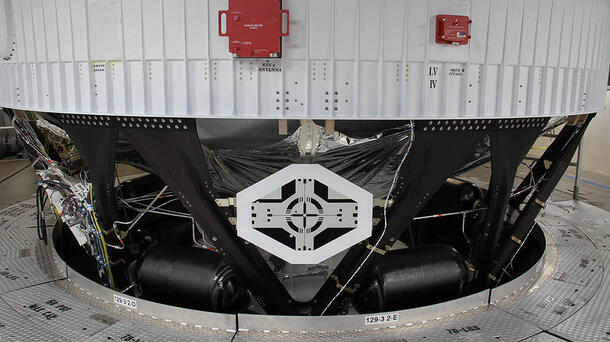
Like the uncrewed Artemis I mission, which took place in 2022, Artemis II will use NASA’s heavy-lift Space Launch System (SLS) launch vehicle to send Orion on a journey to cislunar space and back. Both mission profiles have Orion entering Earth orbit before striking out for the moon. However, Artemis II, scheduled to launch in early 2026, adds a second orbit during which the spacecraft will tango with the SLS’ Interim Cryogenic Propulsion Stage (ICPS) that helped put it there during a proximity operations demonstration. The stage has been equipped with an auxiliary target to support the test.
This planned demonstration will give NASA confidence that, during the Artemis III mission, Orion can manually rendezvous and dock in cislunar space with a pre-positioned landing craft that will then take the astronauts to the lunar surface. Current plans call for the lunar landing mission to take place in 2028. Astronauts will transfer to the lander using the Gateway lunar orbiting space station beginning with the Artemis IV mission.
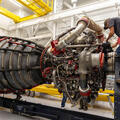
Both SLS and Orion rely heavily on L3Harris propulsion, from the SLS’ RS-25 core stage engines to small thrusters that control Orion’s orientation for atmospheric re-entry. In between are the ICPS’ RL10 upper-stage engine and the Orion Main Engine (OME) used to propel the European Service Module, or ESM.
On Artemis I, the RL10 conducted three burns: one to raise Orion’s orbit; one to hurl it toward the moon, a maneuver called trans lunar injection (TLI); and one to dispose of the jettisoned ICPS. At roughly 18 minutes, the Artemis I TLI burn was the longest ever for the RL10, variants of which have been in service since the 1960s, according to Reed Kakuska, RL10 Chief Engineer at L3Harris.
Artemis II similarly calls for three ICPS burns, but the second will leave Orion and its attached ESM in a stable, highly elliptical orbit ranging between 115 and 46,000 miles above Earth. The ICPS will then separate from the Orion/ESM and serve as a target for the manually controlled docking demonstration where the crewed spacecraft will maneuver around the specially marked rocket stage.
At the conclusion of the demonstration and other tests during the 23.5-hour orbit, including testing Orion’s life support systems, the ESM will fire its OME to escape Earth’s gravity and make its way to the moon. The ICPS, its mission completed, will fire one last time to put it on course to re-enter the atmosphere over the Pacific Ocean.
Although the RL10 will not break any records during Artemis II, getting Orion into its highly elliptical orbit is still plenty demanding, Kakuska said. “The TLI burn on Artemis I was just a little bit longer,” Kakuska noted, adding that the RL10 still provides most of the energy needed to get to the moon on Artemis II. “The service module just gives it a nudge,” he explained.
The fact that NASA entrusts both systems with such critical maneuvers is a testament to their long track records of reliability and adaptability – traits that are indispensable to the nation’s resolve to maintain its leadership in space exploration.