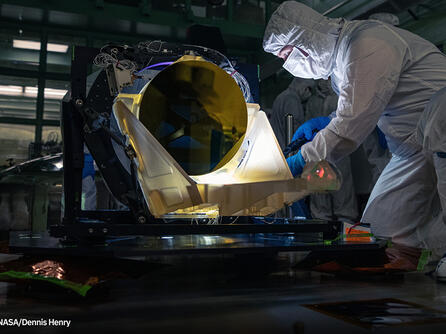
As space becomes increasingly contested, the ability to rapidly deploy and replace satellites will prove decisive. L3Harris Technologies is addressing this challenge through additive manufacturing (AM), accelerating production of in-space thrusters to enable rapid deployment and replenishment of proliferated U.S. national security constellations and other dynamic space operations.
In-space thrusters come in all sizes and are used for satellite deployment, orientation and maneuvering. Traditionally, they are among the pacing items in satellite manufacturing, taking an average of 18 months from order to delivery.
That’s not fast enough for a space-dependent national security community looking to deploy satellites in larger numbers with enhanced maneuverability on compressed timelines. As a trusted, long-term supplier of reliable in-space propulsion systems for critical satellites, L3Harris is answering the call by transitioning key component production from traditional machining to faster and more agile AM techniques.
“Our objective is to enable significantly reduced lead times on propulsion systems that traditionally have been a bottleneck,” said Kristin Houston, President, Space Propulsion and Power Systems, L3Harris. “The goal is to remove up to 12 months from the in-space propulsion system delivery equation and we’re well on track to achieve that.”
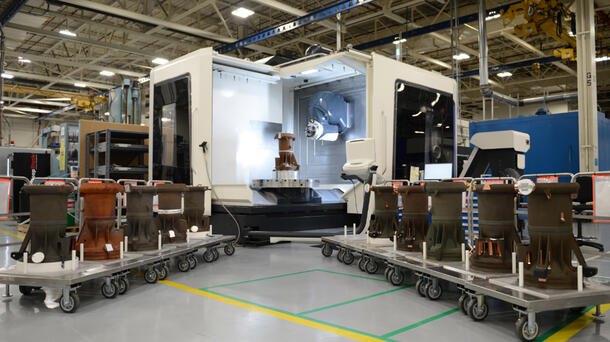
L3Harris has been a leader in AM, also known as 3D printing, for the past decade. The company significantly enhanced its AM capabilities with its 2019 acquisition of 3D Materials Technology in Daytona Beach, Florida. The facility now handles production of key thruster components including nozzles, manifolds and combustion chambers that previously were machined at other L3Harris facilities.
These components are often made from niobium and other exotic, high-strength, heat-resistant metals that can withstand the rigors of spaceflight. Machining large blocks, or billets, of these expensive materials into complex engine components through subtractive manufacturing can be wasteful and inefficient.
With AM, by contrast, L3Harris can buy these metals in powdered form, which is less expensive and easier to store. A manufacturing process commonly used at the Daytona Beach facility is laser powder bed fusion, which entails creating a thin layer of powder on a platform and using a high-powered laser to melt that powder in selected areas based on computer-aided designs. The melted powder fuses and then hardens to create a layer of the part, and the whole process repeats until, layer by layer, the part is complete.
L3Harris has overcome one of AM's biggest challenges: variability in quality between identical machines. Through extensive testing and fine-tuning, the company minimized variability to enable production at scale and take advantage of AM's key benefits, including reduced part count, increased design freedom and shortened build-to-test timeframes for rapid iteration and design refinement.
“The idea is to have multiple machines running simultaneously to achieve scale,” Houston said. “L3Harris-built thrusters with additively manufactured components are now flight proven on national security satellites, both experimental and operational.”
L3Harris’ embrace of AM is not limited to satellite thrusters. AM is also being used on the company’s RL10 engine, which powers the upper stage on United Launch Alliance’s Vulcan family of rockets.
“We’ve been perfecting this over a decade,” Houston added. “We’ve got the infrastructure and people with the proper training in place. We’re already demonstrating high production rates.”
L3Harris’ efforts to accelerate thruster production extend beyond AM. The company is also stockpiling valves and other components that are used across different satellite propulsion systems.
In combination, these efforts are rapidly addressing what has long been a critical pacing item in manufacturing the satellites on which the nation increasingly depends for its security.