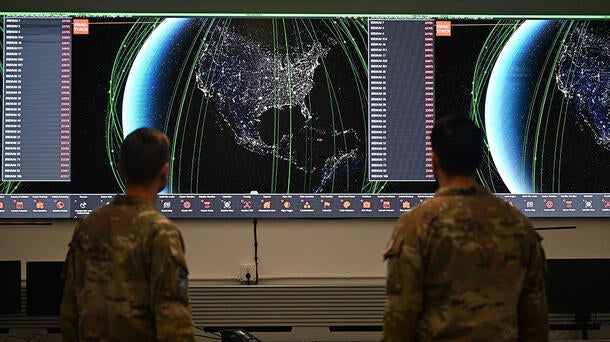
L3Harris is modernizing the Space Force’s Atlas system to improve the ability to monitor satellites, space debris and emerging threats in space. As Atlas transitioned from initial operational acceptance to mature system status, three major enhancements are positioning the system as a transformative platform for 21st-century space operations – all scheduled for 2027 delivery.
"When our warfighters depend on space capabilities for communications, navigation and intelligence, we can't afford blind spots," said Jeff Hanke, President, Space Systems, L3Harris. "This technology gives them the situational awareness needed to operate with confidence and responsiveness to threats before they become crises."
Three Pivotal Atlas Upgrades
Infrastructure Transformation: Cloud Migration and Geographic Expansion
The U.S. government's renovation of Mission Processing System (MPS) infrastructure at Naval Support Facility Dahlgren, Virginia, will integrate Atlas with cloud-based architecture, achieving two critical objectives: extending mission capabilities to the East Coast and doubling user capacity.
Under U.S. Space Force Combat Forces Command’s Mission Delta 2 – Space Domain Awareness, the 19th Space Defense Squadron (19th SDS) Atlas upgrade at Dahlgren NSF scheduled for early 2027 will become the backbone of geographically distributed space operations, connected through high-speed networks enabling seamless collaboration between the 19th SDS and the 18th Space Defense Squadron (18th SDS) at Vandenberg Space Force Base, California.
This enables enhanced mission assurance through geographic redundancy and reduced latency for East Coast decision-makers. If one site experiences disruption, operations continue without capability degradation for warfighters.
International Collaboration: Five Eyes Releasability
With an anticipated Q1 2027 delivery, this secure system will enable Australia, Canada, New Zealand, the United Kingdom and the U.S. to exchange critical space domain awareness data in real-time. The capability enables automated sharing of space object tracking data, conjunction warnings, and anomaly detections – replacing current manual processes for rapid information exchange.
Building Operational Readiness: The TTX Environment
L3Harris's dedicated Test, Training and Exercise (TTX) capability creates a separate environment from operational systems for realistic training. Serving both 18th and 19th SDS operations, TTX offers modular training scenarios using historical and synthetic data, crew certification capabilities and complex scenario generation. The system will eventually migrate to a classified domain.
Operators can train on complex, multi-event scenarios, including satellite anomalies, conjunction warnings and potential counter-space activities without disrupting real-world missions. Standardized certification ensures all operators meet proficiency standards before assuming operational duties.
The Balanced Approach: Sustainment Meets Enhancement
Atlas' development strategy reflects a carefully balanced 50-50 split between sustainment and enhancement. Half the effort maintains system availability, addresses cybersecurity, and keeps pace with evolving threats – the essential work that keeps operators’ mission-ready 24/7/365. The remaining half drives optimization work: refining algorithms, improving user workflows, expanding data fusion capabilities, and integrating new sensor feeds.
From Legacy Systems to Modern Architecture
Atlas replaced the Cold War-era Space Defense Operations Center (SPADOC) system to provide updated user interfaces, increased processing capacity, and enhanced capabilities to handle the exponentially growing space object catalog; all operationally essential to ensure continued mission effectiveness for the Space Force. The system now serves as the operational backbone for space surveillance, providing real-time situational awareness of satellites, debris, and potential threats across all orbital regimes.
Atlas integrates data from a global network of ground-based radars, optical sensors, and space-based surveillance systems, fusing this information into a comprehensive operational picture. The system's cloud-based, modular architecture ensures Atlas can evolve with emerging threats – integrating new sensors, incorporating artificial intelligence and machine learning, and adapting to evolving operational concepts.
The MPS currently operated by 19th SDS at Dahlgren, Virginia, processes missile warning and space surveillance data. Its integration with Atlas represents a crucial step in creating a unified, modern space operations architecture.
Why These Enhancements Matter
Space operations have grown exponentially more complex as the domain becomes increasingly congested and contested. The Five Eyes integration recognizes that satellites operate in a global commons – a debris-generating event affects the entire space environment, not just one nation's assets.
Cloud architecture provides scalability to expand processing capacity as the space catalog grows, resilience through geographic distribution that reduces single-point-of-failure vulnerabilities and easier integration of advanced analytics.
The TTX environment addresses the reality that space operations demand split-second decision-making based on complex technical data. Operators must distinguish routine satellite maneuvers from potentially hostile activities while managing information from dozens of sensors and thousands of space objects. Traditional classroom training cannot fully prepare operators for these cognitive demands.
The Path Forward
As 2027 approaches, these enhancements will continue Atlas' transformation from a SPADOC replacement to a system enabling distributed, collaborative and continuously learning space operations. The system ensures the U.S. and its allies maintain the awareness, understanding, and decision-making speed necessary to protect vital space capabilities in an increasingly competitive space domain.